
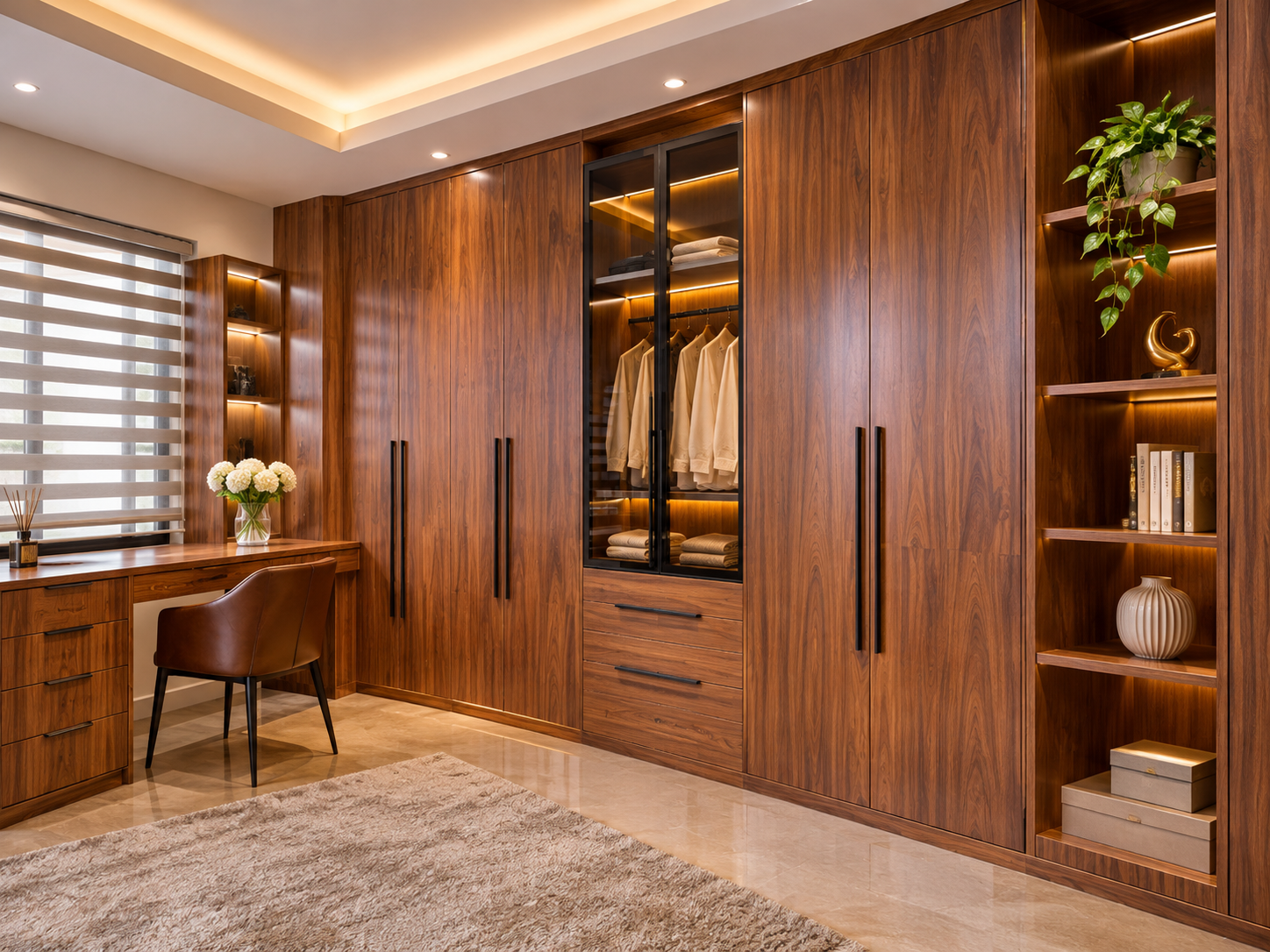
In tropical West Africa, timber joinery is subject to significant seasonal shifts in relative humidity. Wood naturally absorbs and releases atmospheric moisture, leading to dimensional expansion, cupping, or joint separation if material selection and construction detailing are neglected.
1. Seasoning & Kiln-Drying Benchmarks:
For interior cabinetry and furniture in Ghana, solid timber must be seasoned to an equilibrium moisture content (EMC) of 10% to 12% before machining. Utilizing unseasoned timber inevitably leads to shrinkage cracking when installed in air-conditioned residential or corporate interiors.
2. Hardwood Species Stability:
Species such as seasoned Odum (Iroko), Mahogany, and Wawa are selected based on their specific shrinkage coefficients and natural resistance to insect infestation. Odum is preferred for heavy-use entrance double doors and boardroom tables, while stabilized marine-grade substrates form durable kitchen cabinet carcasses.
3. Expansion Joint Detailing:
Solid timber paneling and wide tabletop assemblies must incorporate slotted screw fixings or floating panel grooves that allow transverse movement across the grain without stressing joint fasteners.
4. Protective Multi-Coat Finishing:
All faces—including concealed cabinet backs and bottom edges—must be sealed with high-grade polyurethane or moisture-curing sealers to provide an impermeable moisture barrier against tropical dampness.
← Back to All Insights
GLOBAFIELD Technical Editorial